
Iraq War Documentaries on Must-See List
War Made Easy
No End in Sight
The War Tapes
I have yet to see any of these, but want to see them all. Surprisingly, No End in Sight is playing in Alpine of all damn places.
War Made Easy
No End in Sight
The War Tapes
I have yet to see any of these, but want to see them all. Surprisingly, No End in Sight is playing in Alpine of all damn places.
Round 1, featuring the battle of who asks the better reader poll questions. Al Jazeera asks questions like, "Do you support the Pakistani supreme court ruling that permits Pervez Musharraf to stand for re-election as president?"
Yes, No, or Don't Know?
Whereas Cnn.com usuallly asks questions like, "Are there kitties in heaven?" "Pancakes, waffles or crepes?" "Is Hillary Clinton's cleavage a distraction?" "Are Cheerios, like, donut seeds?"
For real news, bookmark:
http://english.aljazeera.net/English
This is incredibly long, probably the longest thing I've ever sat down and typed up from a book. It's also fucking hilarious. It's from "The Middle Mind" by Curtis White, and I strongly urge everyone to take time to read it. It is so dense with great ideas, and I honestly think it's one of the most intelligent and temporally-relevant things I've ever read. (don't let it bother you that the Middle Mind is not defined here, it's generally a dangerous mindset that never thinks critically. The lack of definition shouldn't detract from this "film reading.")
...A few years ago we had the opportunity to see Spielberg's much-lauded movie Saving Private Ryan, a movie that returned us to a certain narrative ground - the war saga set in the battlefields of Europe during World War II - for what seemed like the first time since Burt Lancaster and company put all those hoary conventions emphatically to rest in the surreal Castle Keep. Since the events surrounding 9/11 and the rebirth of jingoistic patriotism on these shores, the assumptions of Saving Private Ryan have become something like national legal tender. Because of this film, old memorials to the War are being burnished and new ones are being built. Worse yet, this film has played an important part in the broad propaganda effort that legitimizes our current thinking about the necessity and usefulness of war in places such as Iraq. But what might our conclusions about this film be, what might our considerations of Spielberg as an artist be, if we were to seriously consider the narrative structure of this film? I ask this question because I don't believe that most movie viewers think seriously about what's being presented to them in films like Saving Private Ryan, and I'd like to know how actually thinking through such art would change how we think about these films, change the enormous presence of the Middle Mind, and change, finally, what we expect from art and what we want in this world of ours.
I have discussed this movie with several distinct groups of friends as have many viewers of the film, both in the privacy of our homes and on the messy public airwaves of "talk radio." I have been surprised that my friends - intelligent, sophisticated people on the whole - had no idea what I was talking about when I elaborated my understanding of the film's "lesson." At one level, as the film's title announces, it is about the last surviving son of a family and the heroic efforts of a platoon of American soldiers to find him and return him safely to his mother. But at a second level, Private Ryan is about a command not to kill a German prisoner who then returns to kill Americans, most notably heroic Captain Miller. Thus the movie's frightening lesson (one that I've come to think of as archetypally North American) is: always choose death, for if you do not, death will come anyway, later, multiplied.
When I called my friends' attention to the fact that Spielberg had chosen to have the initial decision not to kill made by a multilingual intellectual (and coward!), their response was usually along the lines of "What's Spielberg got to do with the fact that he was a coward?"; "I didn't like that guy"; "He was spineless." What I finally had to conclude was that while I was treating the character of the intellectual Upham as part of Spielberg's artifice, as an important element in an artistic structure, which structure once in place could be asked to reveal its meaning (and perhaps Spielberg's ideological baggage), my friends saw these characters as. . . real people. They understood them in the same way that they understood the cashiers who sold them their tickets and popcorn out front. Upham was a coward in the same way that the snack bar cashier was a little on the chubby side.
In short, my ominous conclusion was that they didn't know how to "read" the film. That is to say, they didn't know how to abstract the integument of structure from a piece of narrative art in order to begin to talk about how the thing means (i.e., creates an ethical world).
And if my intelligent, art-savvy friends didn't know how to do this, what was going on with all of the blunt teenage receptors (mostly boys) that filled the theater on the evening that I first saw the movie? "BOOM!" Was that it? Or should I have worried that the message about the imperative to choose death was also at some subpineal level oozing in and around their minds?
And where does Spielberg fit in all this? Is he a sort of modern-day Albert Speer? A brilliant technician in the service of sinister ideals? Or is he just mouthing a bunch of dumb platitudes and aping convential gestures with no more awareness of the meaning his story creates than his bluntly receptored audience has?
All of which is to say that a simple movie-going experience is in fact a problem of both political and literary scope. What does it mean when the most sinister ideological notions pass virtually without comment in mass culture narratives because the audience is not interested in deciphering (or does not know how to decipher) what is in the film? Worse yet, what does it mean when these essentially unread artifacts are then blandly taken up by the instruments of the Middle Mind as America's art?
When I am asked, strolling away from the cineplex, whether I "liked" one of these heirs to cinematic art, I invariably say, "Yes, I liked it," or "No, I didn't like it," whatever aesthetic force my "liking" might have. But I also feel rather dumb about acknowledging a world in which liking or not-liking are my only options. When we capitulate in this way, aren't we just saying we're no better than Beavis and Butthead? This sucks, that rocks, this is awesome, and everything is just finally a lot stupid. Of course, this is a perfect state of affairs for the culture of the Middle Mind, which thrives on the thoughtless and ephemeral enthusiasms that it presents as culture.
For a literate culture that understands that our narratives do serve to contruct what we are, what our "content" is, and that trusts that the citizens to this culture know in some ultimate way what it means to read so that we may have some basis for moving among narrative options, this all implies a crisis of proverbially nightmarish proportions (oh, a quiet crisis, to be sure, in between the simulated explosions of mortar shells and other forms of synthetic, orgasmic, cinematic bliss). But without the self-consciousness that reading provides, we cannot think our culture, we can only be thought by it. In short, being able to read is a large part of what it means to be human as opposed to being a mere social function.
So, I'm going to "read" Saving Private Ryan. I think a reading can expose this film for what it is, a crypt-fascist work of historical revision. It's not even revision. It's a retrieval from a very dark place. It's: "Remember what we used to think? About patriotism? The glory of war? Let's think that again, and really mean it, so that it will be harder than hell to dislodge it next time." Which is to say, this is a very dangerous movie.
OPENING CREDITS. Dreamworks. A little boy perched on a crescent moon, fishing. Suggestions of Huck Finn and Walt Disney. In fact, thinking of Spielberg as our latter-day Walt Disney is revealing. Both men have been responsible for providing our national fantasy so that we aren't bothered by the obligation to have imaginations ourselves. Why be bothered with the nonproductive work of fantasy when the Unca Walts of the world can do it for us and stay neatly inside the ideological lines? By the way, has anyone seen Walt's cryogenicized corpse recently? I'm not implying anything. Just asking.
THE AMERICAN FLAG. The first and last images in this movie are of the American flag, translucent, brilliant, rippling in the wind.
How are we to understand this flag? Why is it in the movie? Is it ironic? I'll just go ahead and tell you - no, it's not ironic. Nothing in this film undercuts or asks us to think about the flag's traditional, weepy appeal. This movie is yet another announcement of the death of sixties-style thought. This is not Zabriskie Point, not Slaughterhouse Five, not Catch-22, and certainly not Castle Keep.
Or is the flag present in the movie because, well, flags are always in WWII movies? Is it a purely generic concession? That would be really stupid, if that's the case. It therefore very possibly is the case.
OPENING SCENE. Normandy. The aging WWII vet totters toward the grave of. . . we know not whom. Behind him comes his family. There's something intereting about this family. What the camera most encourages us to see is the three granddaughters, in their late teens, arm-in-arm, blonde, sweaters stretched over large (but not improperly large), round breasts. Ooh, they are well-titted, these little American wonders. They are the fruits of victory. Here, the film's purported "big" question, "Have I led a good life?" is answered. Hell yes. Look at these blonde babes my genes have launched. It's Aryan eugenics hybridized with Hollywood's sense of the good life. If the Nazis had won, and Hitler had settled down in Burbank, he wouldn't have thought any different.
My emphasis on the function of these beautiful girls may seem perverse. Obviously, they don't play a large role in the movie. But I would insist that this film, like any novel, is an artifice. If there's something in it, it's there as a matter of artistic choice. The question then becomes, Why did Spielberg choose to have blonde, large-breasted granddaughters standing behind old-man Ryan as he asks the movie's putative big question? Is it because if there had to be girls in the film they might as well add to the general "beauty" of the product by contributing nice bazooms? Perhaps. This cynical, commercial, Hollywood-generic answer is certainly very plausible. Or is it, as I would also contend, that the girls are an implicit answer to the question that has no explicit answer, "Did I live a good life?" Think how the resonance of this question would change if Ryan had returned to Normandy alone. Or if he had gone only with an ill-kempt and frowsy wife without evidence of handsome offspring. Or what if the daughters had lip and nose piercings and punk-blue hair? One way or the other, the response to the presence of the girls that is inadmissible is "It just happened that he had granddaughters with nice blonde hair and handsome chests. So what?" The "so what" is that those girls are not his granddaughters. They came from casting central, to which they were admitted in the first place because, in large part, of their Hollywood-appropriate bosoms and lovely locks. Consequently, we ought to conclude that they are present for two reasons. They are a Hollywood tautology (Hollywood movies have Hollywood-looking women in them), and they answer the narrative question, "Have I lived a good life?"
THE FLASHBACK. We look into the still-nameless vet's eyes. They take us back to the beach. Omaha Beach. Tom Hanks as Captain John Miller.
This is brilliant moment. One has to pause and admire Spielberg's shrewdness. First, casting Hanks (a notorious softy) in this role was extraordinarily smart. He softens all the hard edges of this "war film." He reassures us that this will not be another Pork Chop Hill or Ballad of the Green Berets. Sure, Spielberg remembers Vietnam. He wouldn't make some macho war flick. Hanks is no John Wayne. Therefore, the film cannot be another VFW flack-piece. Shrewd.
Also, there is the narrative stratagem, the sleight of hand. We move from the eyes of the old man (who is in fact Private Ryan) to the viewpoint of Captain Miller (which Ryan could not possibly know). This is inspired cheating! Through it Spielberg maintains the narrative question: Who is the old man? This is very deft narrative manipulation.
THE LANDING. Truly horrific. These first minutes of the film are visually stunning. War's horror (or a techno-wizard's vision thereof) is really captured. The claustrophobia of the landing boats and the water. The slaughter of the good guys into whose angular faces we had just been looking. These are authentic American faces right out of Dorothea Lange's Farm Security Administration photographs of the 1930s. In a time like our own when the next generation of country boys and urban boys, our "volunteers," line up in order to take their part in the next mechanized slaughter (of little brown men, mostly, from Iraq or some other land-of-the-little-brown-people), this could be the opening of a morally engaging movie about the violence of war.
But it's not.
The tableau of the beach scene is stunning. Beautiful to see on the screen. Kubrick-like in its grandeur. Incongrous, too, given what has just preceded it. These men and machines integrated with the green and blue of nature. As the Italian Futurists used to say, "The deaths do not matter as long as the gesture is beautiful."
I think that just about every American movie expresses the conviction that there's something beautiful about death, especially violent death. It's in depicting death that our cinema can most be said to have style. Violent death is our primary super-aesthetic. This is true even of oughta-know-better directors such as Martin Scorsese (as his epic study in urban carnage Gangs of New York has recently confirmed), and it's certainly true of the ragtag rest.
THE PLOT. A platoon is sent behind enemy lines to rescue the last of four brothers, three of whom have already been killed in action. Some guy who looks frighteningly like Bob Dole playing George C. Marshall reads a letter by Abe Lincoln and everybody breaks down in tears and hysterics of patriotism and love of mother. Never mind that the letter doesn't make any sense in the context. In fact, because Lincoln's letter is about the loss of all of one unfortunate mother's sons, lost in the Civil War, Marshall ought to be encouraging the mother to say, "Well, hell, take the last one too. On that fucking glorious field of battle you talk about so purtily."
Forget this plot. It's a red herring. A sentimental red herring, if such a thing can be imagined. It's a cover for the real story.
THE FIRST EXECUTION. Early in the movie, immediately after the Allies take the beachhead at Omaha, two surrending Germans, hands held high, are shot by two Americans soldiers.
Soldier 1: "What did he say?"
Soldier 2: "Look, I washed for supper."
This cynical and murderous moment is of course the companion to the critical moment later in the film when Upham intervenes in the execution of the German prisoner. Writers pair similar moments in narrative in order to make clear their intentions, emphasize a theme, or provide self-commentary. How does the light of this first scene - which is disturbing in its cynicism and callousness - help us to understand Spielberg's moral purpose in the second and central execution?
THE SECOND EXECUTION. This scene (a depiction of a desperate human clinging to the threads of his life) is as well delivered by the actor Joerg Stadler as any in memory since John Turturro's tour de force performance in Miller's Crossing. The actor brilliantly captures the idea of the Enemy-Other-as-Human. His pathetic attempt to render "The Star-Spangled Banner": "I say can you see." Upham successfully argues that the German should be allowed to live. One sees the moral rightness of Upham's argument. After all, what they proposed was murder. The German was a POW and had certain rights under international law. Upham knew this. Surely, murder was not what the USA was about.
What allows Upham's argument to persuade Captain Miller is the fact that Miller is an intellectual himself (he's a teacher, he quotes Emerson). He is unlike Upham only in that he has by force of brute will obliged all cowardice from his own body except for his symptomatically quaking right hand. This hand, foregrounded by Spielberg again and again, is synecdoche for the general cowardice of intellectuals. But Miller is bravely determined that he will not allow cowardice to dominate himself in particular.
Of course all this is called into question later. Matters are complicated at the film's climax when (and here is Spielberg's deux ex machina at its extreme) this same German prisoner returns to shoot and kill heroic Captain Miller. The German peers in satisfaction. It was a good shot. Fuck that American schweinhund. Him and Betty Boop. Meanwhile, the cowardly intellectual Upham cringes in a crater, hugging his feckless rifle as if it were a favorite and comforting doll. The contempt we feel for him. Our self-disgust at once having sympathized with his intellectualization, his reasons. Our national sorrow that the great man, Captain Miller, must die as a consequence of Upham's lack of manliness. We'll never make that mistake again. We'll go with what our gut tells us.
THE GREAT CHANGE. Immediately following Miller's death, Upham experiences a great change. It is as if Miller's courage has flowed over to Upham at the moment of his death. The son Upham becomes the father Captain Miller. Upham leaps from his hiding place in the crater - nervousness gone, rifle at the ready, the very image of resoluteness, of hard experience. He improbably persuades six or seven Germans to drop their weapons (instead of shooting the hell out of him). One of these soldiers is, of course, our German prisoner, the guy upon whom Upham had wasted his powers of compassion and ethical reasoning. Hopeful that again his naive advocate would aid him, the German gestures hands forward and says, "Upham!" Buddy! At which point Upham murders him. In the logic of the film, he does what should have been done the first time.
Do I need to say this? The second meeting between Upham and the German is not ironic. It is contrived. Spielberg is insisting on our attention to this point. We will not be allowed to miss his meaning. And a brutal meaning it is. Emotionally, it is clear that Spielberg anticipates that the audience's response to Upham's act will be full-throttle approval. "Yeah! At last! Revenge is sweet! Just what that treachorous Kraut deserved." (I really never imagined that I would ever again be given license to hate Germans. But for the length of this movie, at least, they are again Krauts. Their appeals to their common or shared humanity are all duplicity and self-interest. They are what they are: Nazis. Krauts. If death is theirs, it's fitting.) Thus the film's murderous thesis is fully disclosed. Self-survival, the survival of the good, requires that one choose death. The cynicism and brutality of the first executions back on Omaha Beach are excused in their fact if not in their style. Bad table manners, perhaps, but in murdering the prisoners the American soldiers did what they had to do. This is advocacy of international vigilantism and no whit more self-reflective than any Dirty Harry narrative.
It's the sort of moral imperative that ought (and how contrary is this ought!) to make us understand why those on the wrong side of our national self-righteousness and cruise missiles ("pharmaceuticists" in the Sudan and other Muslim countries, for example) have this imponderable desire to blow up our embassies. Could it be because they understand (as they should!) our national logic better than we do? Aren't they saying to us, "You know, it's easy to choose death for other people. Let us show you how it feels to have death chosen for you. Arbitrarily. A bolt from the clear blue."
CLOSING. With the words of Abraham Lincoln echoing in the background (pride, sacrifice, glory, freedom - it's 1915 again and we're all dying sweetly pro patria!), the weepy vet returns to the screen. We know now that the man is Ryan. And the question he asks (a question that is really a narrative non sequitur, given the film's foregrounding of the Upham story) is: "Have I lived a good life? Have I been a good man?"
Well, with his granddaughters' lovely bosoms still hanging like a majestic sunset in the background, how can we say anything but yes?
Or, more reasonably, well, how the hell are we supposed to know if the poor son of a bitch led a good life? His wife doesn't look beat up. But that nose! How much gin did you knock back, Papa? How much TV did you watch? How many peaceniks did you rail against during Vietnam? How many Nazis did you help elect to Congress, with your little democratic ballot, so like a bullet to the rest of the world? What do you think of Rush Limbaugh and Newt Gingrich? Do you hate eggheads as much as Spielberg seems to think you should? How many times did you curse the EPA because it got in the way of some concrete you wanted to pour?
Sorry if these questions are inappropriate, but you don't fool me. I remember those VFW papas well. I remember their malice for the Japs and Krauts. The gooks and the slants. I'm patient. I can wait for your responses to my questions. But till you have them, you'll excuse me if I don't join this orgy of nationalist amour propre uniting VFW dads and their contrite sons. (Hasn't that been a sight at the local cineplex!) We should all know too well what such self-love is a preparation for.
So, that's it. Incredible. Understandably, posting this violates copyright laws I'm sure, so I'll take it down HarperCollins, if desired. But, having read it, if you feel the same way about it as I do, you'll purchase your own copy. It's a complex read on the whole, and I'm only about halfway through. White rails against not the bottom of the intellectual barrel, but rather the middle, and I think he pissed off a lot of people with it because they thought his targets should be more obvious.
So, god is pretty much rocking the shit out of us in Lubbock, TX today. I was going to have a drink...or five...at a local pub with some fellow work mates. We decided a place to go and then left the building of Mass Communications.
Now, before I continue with this, I want to remind all of you lovely readers than I work in the basement of said building. The other gentleman that was going to journey with me to the pub also works in the basement. So, basically I never know what the weather is doing until I leave to go home...or like today, the bar.
We walk out and notice it's starting to rain and it's pretty damn windy. And cloudy. Since there is construction pretty much surrounding Texas Tech campus, the wind also carries dirt. So, we are walking to our cars, being blown sideways by the wind, getting wet from the rain, and getting dirt in our eyes and mouth - also thanks to the wind. We leave to meet at the bar. While driving, it begins to rain harder and faster. Their is debris flying all over the place from the wind. Also, while trying to get to the bar, I notice several trees have been knocked down. The rain is coming down much harder and faster now; In fact, I can barely see anything and my wipers were on the fastest wipe setting. I thought about pulling over till it clears up...now, before I continue, let me tell you that storms in Lubbock either last for days or a few seconds...so I thought if I pulled over and waited, I could eventually continue driving when things cleared up a little.
Well, this would normally be a great idea. But Lubbock has a HUGE problem with flooding. So, if I pulled over anywhere along the way, it probably would have been worse, ie: my car could have gotten stuck or flooded out or something.
Oh, and did I mention the hail. Yeah, it also started hailing. So hard I was afraid my windows would crack and break and then it would raining (actually flooding) in my car.
So, I called my co-worker and we decided to take a rain check. Probably a good idea, given the hail, rain and winds.
Since I was heading towards my house anyway (the pub we were going to is close to my house) I headed on home. Well, I could still barely see anything. I was pretty scared. Finally I made it home to find the power had gone out twice. It went out twice more since I have been home. We (Eric and I) watched the news to figure out anything we could. Well, they were saying the storm was "blanketing" Lubbock with pea to marble size hail, massive amounts of rain, and 50-60 mile an hour winds. The best thing, they never really mentioned where this god-shitting on lubbock-type storm came from. It was a miracle storm. A shit-miracle storm.
I'm not saying storms like this don't happen elsewhere. But here in Lubbock, TX, one of the claimed buckles of the Bible Belt, we tend to get storms out of nowhere and then within minutes, they are gone. Actually,as I am finishing this, I can see the clouds moving on. This afternoon when I went to lunch it was great...well it was clear and sunny (I am a fan of cool, cold, cloudy weather).
I am sure there is an explanation for this...god likes pissing on Lubbock. Really, I mean this happens all the time. We will have a storm, within minutes it will clear up and it will look like nothing happened. Last winter, it started snowing one morning. By the end of that same day it was bright, warm and sunny. No more snow on the ground. It looked like there was never any snow on the ground anywhere.
My point is this...Lubbock's weather is fucking crazy. It changed hourly; by the minute even. There is no explanation for it...well I am sure there is, but no one around here seems to know it.
As much as I love cold, cloudy weather, I can not wait to get to a place where there is some standard on weather. A place that actually experiences all four seasons. It must be nice to know what the weather be like for days to come. I can not wait to leave the buckle, to leave Lubbock...to escape the Bible Belt.
A boy band for old gay men? I don't know, but their name is brilliant - Bearforce 1. It's an incredibly, astronomically gay disco medley that I really hope I don't start mindlessly humming tomorrow at work. It's probably the funniest thing I've seen in several days, but I have to admit I'm also a bit impressed by the breadth of the medley.
I was watching “Universal Soldier” (starring Jean-Claude Van Damme and Dolph Lundgren) the other night. I forgot how fucking awesome this movie was/is. I realized that Dolph Lundgren is really the main star, despite what others say. I mean come on, the man was in “Universal Soldier”, boxed Rocky Balboa in “Rocky IV” (note: he also killed a dude in a boxing match in this movie), and played He-Man in “Masters of the Universe.” He played He-Man for fuck sake! Not many actors can say they played He-Man, actually none can except Dolph. I mean this guy is an ultimate badass. Therefore, I have decided to blog about him…
But this is not that blog.
Because I want to do him justice, I have been doing some research. Part of my research has included other people he been in movies with. Since Jean-Claude Van Damme was in “Universal Soldier,” I have started with him; also, I think Dolph would have been much better in “Universal Soldier: The Return” – I saw this movie in the theater with my father, it was a great bonding moment when the few people in the theater (another father/son group and a group of frat-college dudes) cheered when Goldberg speared someone. (starring Jean-Claude Van Damme and Bill Goldberg…yeah, the wrestler).
Come to think about it, I also think Dolph Lundgren would have been better in “Bloodsport,” too.
I lost a little respect for Jean-Claude Van Damme while looking through his list of movies on IMDB.com. Actually, I lost a lot of respect. I tried to forget about a particular movie he did. A movie called “Double Team.” A movie that sounds cool when you hear the title, but then you see who’s in it: Dennis Rodman.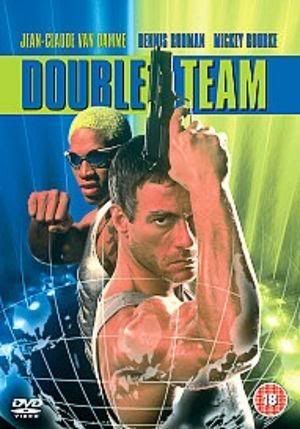
Yes, the same wedding dress wearing, radically hair dying, Carmen Electra marrying, arm and leg flinging while rebounding, Dennis Rodman.
I am sorry, Dennis Rodman should not act. I made the mistake of seeing this movie, it was awful.
Upon loosing respect for Van Damme for co-starring with Dennis Rodman, I then remembered Rodman’s short wrestling career. Yeah, you can add wrestling superstar to Rodman’s long list of wacky antics. He had a brief stint in WCW (World Championship Wreslting for you non-wreslting people) as a member of the nWo (new World order – I have no idea why they felt the “W” had to capitalized and the “n” and “o” lowercase, but whatever.) He tag teamed with Hulk (Hollywood Hulk during his nWo days) Hogan. The faced the team of Diamond Dallas Page (DDP) and another NBA star, Karl Malone.
Rodman also had a feud with Macho Man Randy Savage (for those that follow wrestling – I am not sure if this feud occurred while Savage was a member of the nWo Wolfpack or not).
Sorry for the video, but it was all I could find.
Anyway, I thought this would be a good side blog until I finish the one about Dolph Lundgren. It should be good. Actually, I know it will be good. Also, I was happy to relive wresting memories, even if they do involve Dennis Rodman. I wonder what "The Worm" is up to these days anyway...

It's true. God and I had gone awry somewhere, had bottled up too many things, had left too many things unsaid, and had simply... fallen out of love. Our sex life was laughable. And we fought, oh did we fight - and over the simplest things.
So, we hired Dr. Phil to personally meet with us and cast beams of wisdom and compassion from his radiant cranium into our soiled hearts.
And also Viagra. That helped us out, too. (wouldn't Christboner be a cool name for a metal or hardcore band? maybe even like a deathmetal-christian band)
On another note, are we to understand that the listing is in the order in which we are to do them? Clean the garage? Exercise? Like, does doing some squats come before ultimate transcendence to an eternal heaven? Rippling calves before divinity? Gluteal dominance precedes purity of heart?
God: "No fatties."
